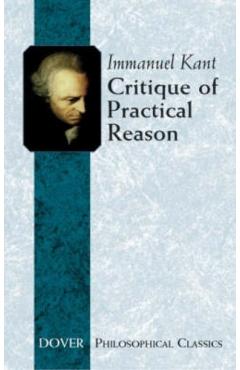
Immanuel Kant
Critique of Practical Reason
Despre carte
The second of Kant's three critiques, Critique of Practical Reason forms the center of Kantian philosophy; published in 1788, it is bookended by his Critique of Pure Reason and Critique of Judgement. With this work Kant establishes his role as a vindicator of the truth of Christianity; he approaches his proof by presenting positive affirmation of the immortality of the soul and the existence of God. The philosopher offers an argument concerning the summum bonum of life: people should not simply search after happiness, but follow the moral law and seek to become worthy of the happiness that God can bestow.
This Critique comprises three sections: the Analytic, the Dialectic, and the Doctrine of Method. The Analytic defines the ultimate moral principle, the categorical imperative, and argues that to obey it is to exercise a freedom. The Dialectic make the assumption that immortality and God exist, arguing that pure practical reason falls into error when it expects perfection in this world; we should anticipate finding perfection in the next world, with God's help.
The final section, the Doctrine of Method, offers suggestions in educating people in the use of pure practical reason. A seminal text in the history of moral philosophy, this volume offers the most complete statement of Kant's theory of free will and a full development of his practical metaphysics.
Citește mai mult
The second of Kant's three critiques, Critique of Practical Reason forms the center of Kantian philosophy; published in 1788, it is bookended by his Critique of Pure Reason and Critique of Judgement. With this work Kant establishes his role as a vindicator of the truth of Christianity; he approaches his proof by presenting positive affirmation of the immortality of the soul and the existence of God. The philosopher offers an argument concerning the summum bonum of life: people should not simply search after happiness, but follow the moral law and seek to become worthy of the happiness that God can bestow.
This Critique comprises three sections: the Analytic, the Dialectic, and the Doctrine of Method. The Analytic defines the ultimate moral principle, the categorical imperative, and argues that to obey it is to exercise a freedom. The Dialectic make the assumption that immortality and God exist, arguing that pure practical reason falls into error when it expects perfection in this world; we should anticipate finding perfection in the next world, with God's help.
The final section, the Doctrine of Method, offers suggestions in educating people in the use of pure practical reason. A seminal text in the history of moral philosophy, this volume offers the most complete statement of Kant's theory of free will and a full development of his practical metaphysics.
Detalii
- Format
- Broșată
- Limbă
- Engleză
- Gen
- Filosofie
- ISBN
- 9780486434452
- Autori
- Immanuel Kant
Toate ofertele
Oferte (1)
- LibrisCumpără61,69 RON55,52 RON-10%